
Precision Surgery to Regain Confidence & Function
Penile Prosthesis for Erectile Dysfunction (Impotence)
Professor Asif Muneer offers internationally recognised expertise in the most effective proven surgical techniques for Erectile Dysfunction, based in Central London.
A huge thank you to Professor Muneer for his expertise and reassurance through the period of initial consultation to surgery. Under very difficult personal circumstances, my consultant has helped me more than he may realise.
Thank you!
Penile Prosthesis Infection Rate
98% mechanical reliability rate at 5 years,
with 97% patient satisfaction
< 0.05%
Significantly below the international benchmark
Erectile Dysfunction
Approximately 40–50% of men over the age of 40 are affected by erectile dysfunction. At Harley Street Andrology, we specialise in identifying and treating the underlying cause of Erectile dysfunction (ED) using advanced diagnostics, regenerative techniques and surgical intervention where pharmacological treatment options have failed.
ED is defined as the inability to achieve or maintain an erection sufficient for satisfactory sexual activity. It can stem from physical factors such as diabetes, heart disease, obesity, or hormonal imbalances, as well as psychological factors like stress, anxiety, or depression.
Medications, such as Viagra or Cialis, lifestyle changes, and vacuum erection devices are common first-line treatments. However, for men who do not respond to these or for whom they are unsuitable, penile prosthesis surgery is a viable option.
This procedure is typically recommended for those with severe ED, including cases following prostate surgery or with conditions like Peyronie’s disease.
Causes of Erectile Dysfunction
- Cardiovascular Risk Factors: Hypertension, hypercholesterolaemia, smoking, or obesity
- Diabetes Mellitus: A leading cause due to vascular and neurological complications
- Hormonal Imbalances: Low testosterone or thyroid dysfunction
- Medications: Including antihypertensives, antidepressants, or antipsychotics
- Neurological Conditions: Multiple sclerosis, Parkinson’s disease, or spinal cord injury
- Post-Surgical ED: Common after radical prostatectomy or pelvic surgery
- Stress, anxiety, or depression
- Relationship difficulties
- Performance anxiety, particularly in younger men
Diagnosis and Management of Erectile Dysfunction
Professor Muneer provides comprehensive diagnostics and individualised treatments for ED:
Diagnosis:
- Clinical History: Assesses symptoms, medical history, and lifestyle. Early morning erections suggest intact physiology; their absence indicates physical causes.
- Physical Examination: Includes
Body mass index (BMI) calculation and genitourinary examination.
Investigations:
- Urine analysis for diabetes
- Blood tests (testosterone, lipids, HbA1c)
- Specialised tests: Penile Doppler ultrasound or novel ambulatory Nocturnal Penile Tumescence (NPT) testing
Treatment Options:
- Lifestyle Modifications: Weight loss, smoking cessation, reduced alcohol intake, and regular exercise.
- Medical Treatments: PDE-5 inhibitors, alprostadil, invicorp, vacuum erection devices, low testosterone therapy (hypogonadism), and psychosexual therapy for psychological causes, often combined with other treatments.
- Surgical Treatment: Penile prosthesis surgery for severe ED.
Penile Prosthesis: A Definitive Solution
Who is it for?
Penile prosthesis surgery is suitable for:
- Men with severe or persistent erectile dysfunction: Those who have not achieved satisfactory results with medications (e.g. Viagra, Cialis), vacuum erection devices, or injections, often due to conditions like diabetes, prostate surgery, or vascular disease.
- Men with Peyronie’s disease: Individuals experiencing ED due to penile curvature or scarring, where a prosthesis can restore both function and form.
- Couples seeking a long-term solution for intimacy: Men and their partners who want a reliable, permanent option to maintain a fulfilling sexual relationship without ongoing reliance on medications or devices.
- Men post-prostate surgery or with pelvic trauma: Those with ED resulting from prostate cancer treatments, radiation, or injuries affecting penile function.
- Men seeking discretion and natural function: Particularly those considering inflatable prostheses, which offer a natural appearance and concealability, with 97% patient satisfaction as reported in Professor Muneer’s practice.
What happens during Penile Prosthesis?
There are two main types:
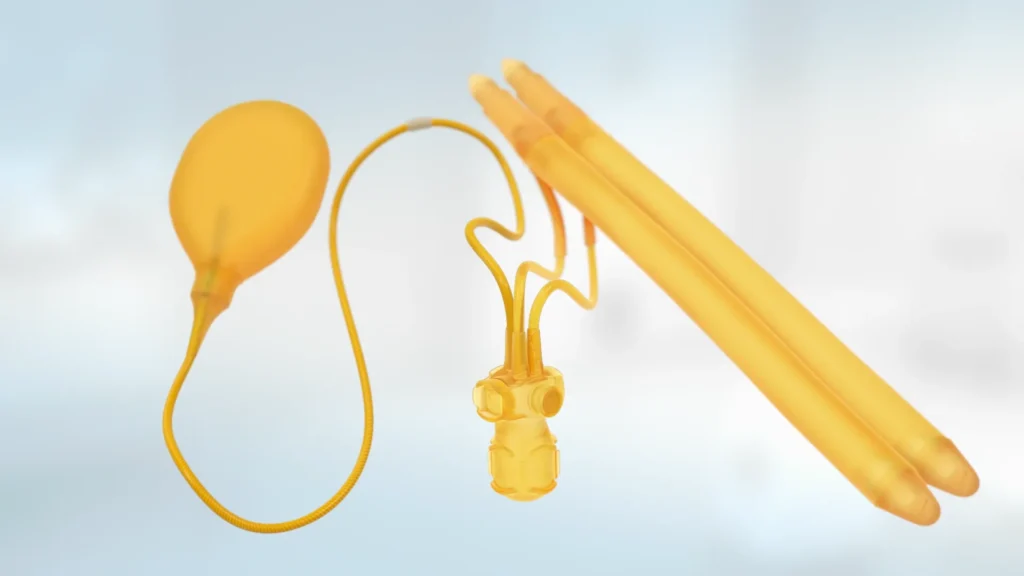
- Inflatable Prosthesis: Cylinders, scrotal pump, and abdominal reservoir; offers natural appearance and 97% satisfaction.
- Malleable Prosthesis: Flexible rods for manual adjustment; simpler but less discreet.
Inflatable prostheses are more popular due to their natural feel and concealability.
Penile prosthesis is performed under general or spinal anaesthesia, typically lasting 1–2 hours, and can often be done as a day-case procedure.
The surgeon makes a small incision, usually in the scrotum or lower abdomen, to insert the prosthesis. For inflatable models, additional components like the reservoir are placed in the abdomen. The incision is closed with dissolvable stitches.
How effective is Penile Prosthesis?
Infection Rate
Professor Asif Muneer: <0.05%
Mechanical Reliability (5 yr)
Professor Asif Muneer: 98%
Patient Satisfaction
Professor Asif Muneer: 97%
Is Penile Prosthesis Safe?
Recovery Instructions After Penile Prosthesis
- Recovery involves mild discomfort, swelling, or bruising for a few days. Symptoms are usually manageable with simple analgesia and cold compresses.
- Light activity can resume within a week, with full recovery taking about 4–6 weeks.
- Sexual activity is generally advised to resume after 4–6 weeks, depending on healing progress.

Useful Links:
4.94/5
View Reviews on Doctify
Professor Muneer’s services are excellent. He’s very understanding and listens to your concerns. The staff are friendly and ensure you are properly informed about any procedures and scans. I highly recommend him to anyone looking for an urology / andrology specialist.
Very understanding and reassuring. Gives clear, understandable explanations and expectations. Very knowledgeable in his field.
Very well talented and mannered. Sharp and explain the treatment in the best way